

Decoding Self-Awareness
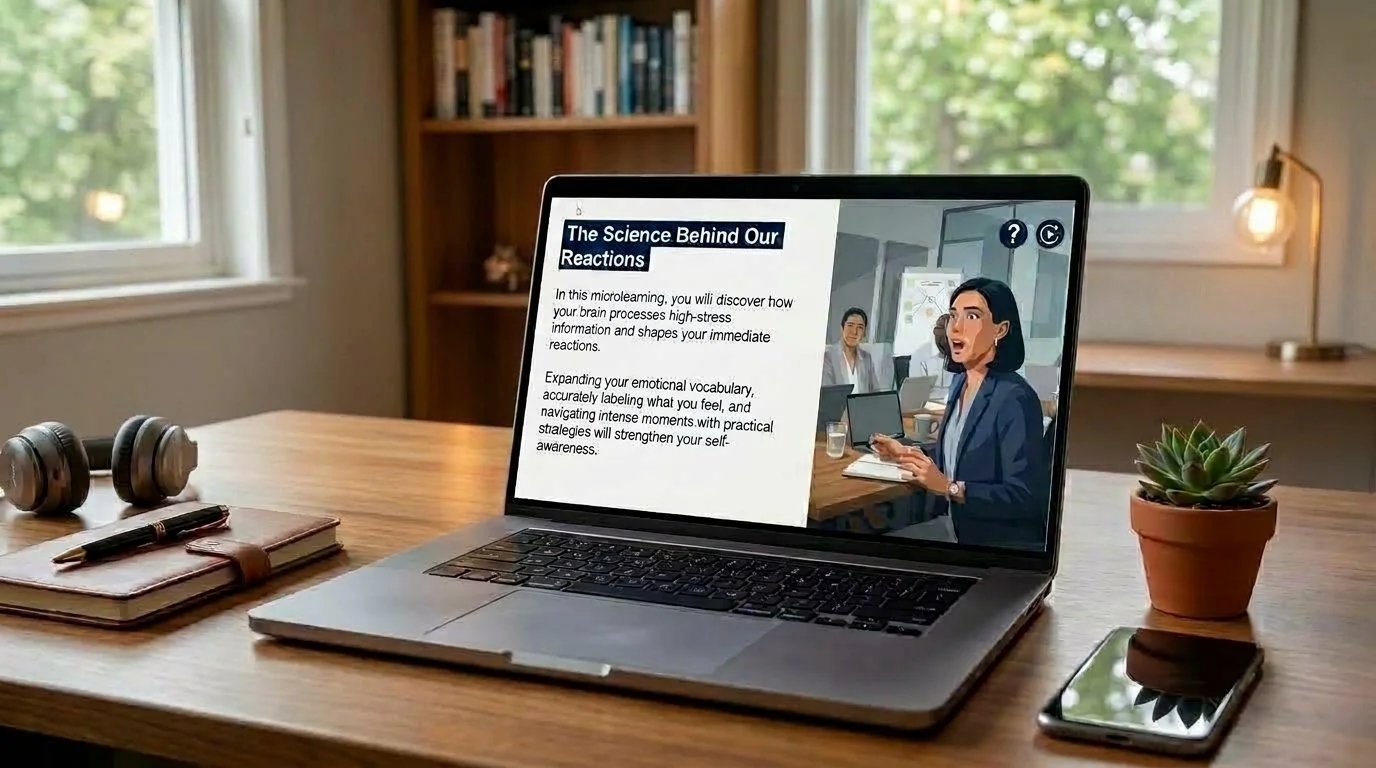
This microlearning helps learners build self-awareness by understanding what happens in the brain when emotions take over, and by learning to calm that response through naming what they feel. AI-generated video scenarios, created in Google Flow, show low and high self-awareness side by side. Three practical strategies give learners tools they can use right away.
Audience: Professionals and people leaders in any workplace who want to build emotional intelligence and handle high-pressure moments with more clarity
Responsibilities: Instructional design, scriptwriting, AI image and video generation, visual design, eLearning development
Tools Used: Storyline 360, Google Flow, HTML, Mindmeister, Adobe Creative Suite, JavaScript
The Problem
I originally developed this microlearning for UCSF Learning & Organizational Development and adapted it for my portfolio with a general workplace setting. Self-awareness sits underneath almost every leadership and teamwork skill, but it's often taught as an abstract idea: "know yourself." Learners hear that it matters without understanding why they lose perspective in hard moments, or what to do about it.
The Solution
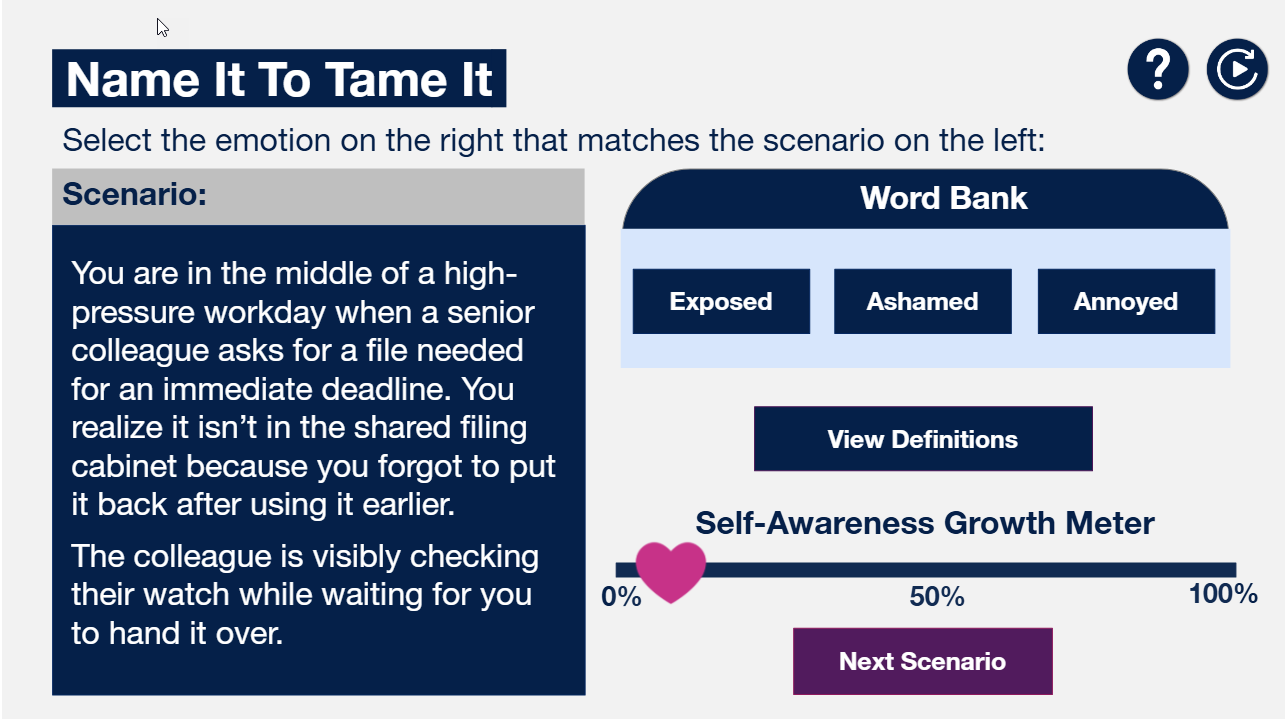
I designed a microlearning that grounds self-awareness in the science of the amygdala, the part of the brain that drives our fight-or-flight response. Drawing on Dr. Dan Siegel's 'name it to tame it' approach and research on affect labeling, learners discover that naming an emotion with precise vocabulary can calm that response and give them back control. I also created activities that help learners regulate their emotions by choosing words that go beyond the five core emotions of happy, sad, angry, afraid, and ashamed.To make the concept concrete, I wrote the scenarios and generated all of the course's images and videos in Google Flow. The videos show the same workplace moment handled with low self-awareness and with high self-awareness, so learners can recognize both in themselves.
The course closes with three strategies learners can apply right away:
Know who or what pushes your buttons: notice the situations that reliably set off a strong reaction.
Seek regular feedback: use others' views to see your blind spots.
Stop treating feelings as good or bad: treat emotions as information, not judgments.
My Process
I started by narrowing a broad topic to one core idea that could change behavior: emotional vocabulary as a tool for self-regulation. The Self-Awareness section was originally part of a larger emotional intelligence course, and I adapted it into a microlearning that busy learners can finish in one sitting (about 20 minutes).
When scripting the video scenarios, I focused on making them feel realistic and relatable, then generated every image and video in the course with Google Flow. Building engaging interactions is my favorite part of being an instructional designer. To help learners understand the amygdala's role, I built a scripted animation in Storyline that shows how we react to alarming information.
Results & Reflection
The course was developed for UCSF but wasn't launched before my role ended due to a team restructure. Working in Flow was thrilling. It showed me how AI can extend what an instructional designer can build alone. Producing scenario-based video used to need a full production team; now I can design, cast, and generate it myself while staying focused on what the learner needs.