

The Next-Gen Edge: Agility Self-Assessment & Development Plan
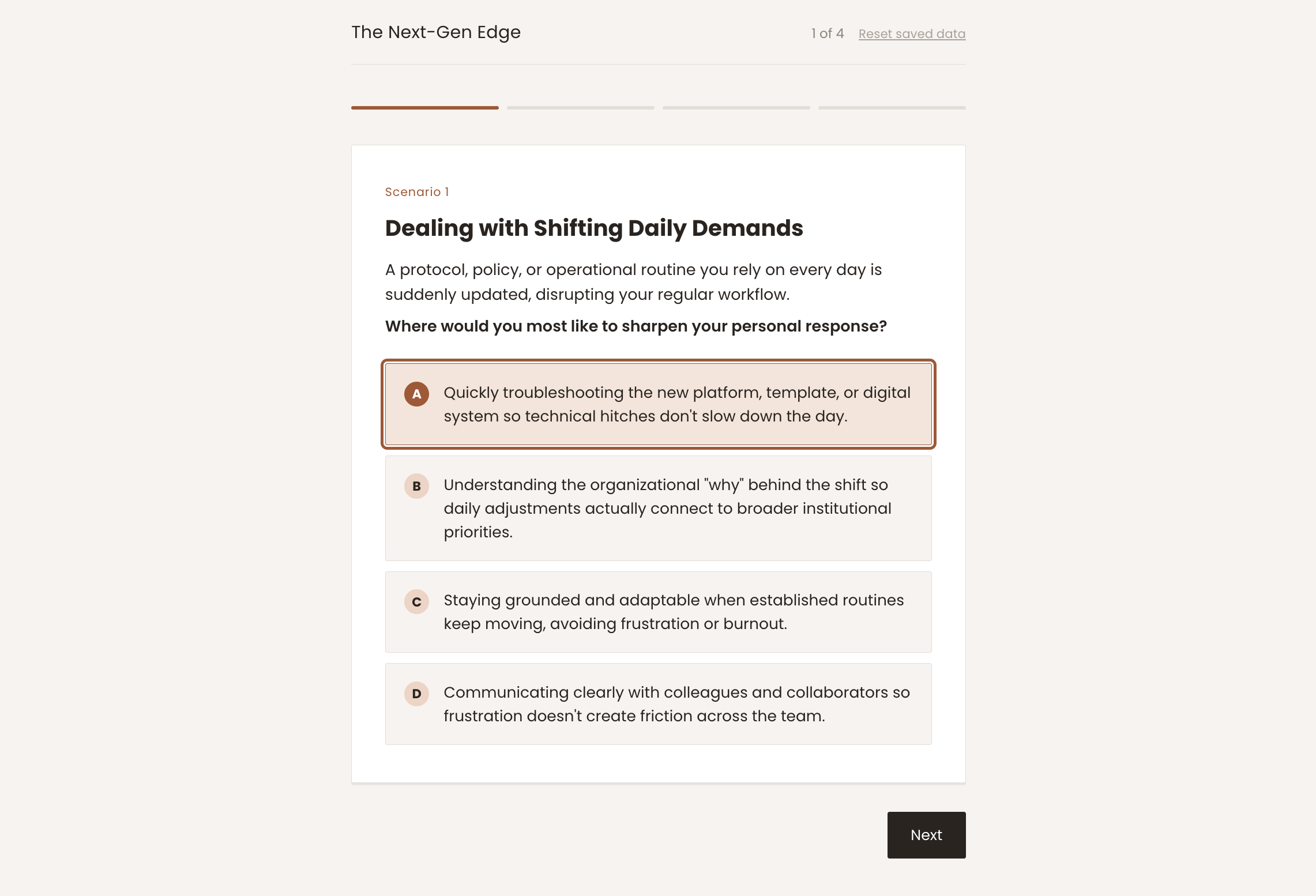
This interactive self-assessment, adapted from my work at UCSF, helps employees measure their learning agility and build a personalized development plan. This interactive self-assessment helps employees reflect on their learning agility and turn what they find into an individual development plan (IDP). Learners rate themselves on key future-ready skills, get personalized feedback on their strengths and growth areas, and leave with concrete next steps they can take to their manager.
Audience: Employees at all levels in large organizations who want to future-proof their careers, and the managers who support their growth
Responsibilities: Instructional design, UX and visual design, front-end development, assessment writing
Tools Used: HTML, CSS, JavaScript, Visual Studio Code, Claude
The Problem
I originally designed this tool for UCSF's Future-Ready Skills initiative, which asked employees to build skills like adaptability and learning agility. But there was no easy way for them to see where they stood or decide what to work on next. The content lived on static web pages, so the path from "these skills matter" to "here's my plan" was missing.
The Solution
I designed an interactive tool that pairs a reflective self-assessment with a guided development plan, and developed it in collaboration with Claude. Learners don't just read about future-ready skills; they assess themselves against them and leave with a plan they own. I kept the assessment brief so learners could finish it in one sitting, added auto-save so they could return anytime, and included a downloadable plan to guide development conversations with their managers. Because it's a lightweight web tool rather than a traditional course, it works as a quick, self-paced check-in that learners can come back to as they grow.
My Process
I started from the existing Future-Ready Skills framework and wrote self-assessment items that turn each skill into observable, everyday behaviors, so learners could rate themselves honestly instead of guessing. From there, I mapped each result to specific development actions so the plan felt personal, not generic.
To build it, I used Claude as a development partner. I led the instructional design, content, and user experience, and directed Claude to turn those decisions into working HTML, CSS, and JavaScript. We refined it together through rounds of testing and feedback until every interaction supported the learner. This approach let me go from concept to a fully functional tool, with auto-save and a downloadable plan, without waiting on a development team. For my portfolio, I rebranded it as The Next-Gen Edge with its own visual identity.
Results & Reflection
Building it confirmed how much I enjoy designing learning that people use, not just complete, and showed me how AI collaboration can expand what an instructional designer can deliver on their own. The tool was designed for UCSF's Future-Ready Skills initiative but wasn't launched before my role ended.